Hello! I've been working with my niece to help her get started in homeschooling her daughter. They live in Minnesota, so this schedule attempts to reflect their state requirements, their seasons (for outdoor, science studies), their outside activities, and the books available through their local library system. I hope it might prove helpful to others getting started on the road to homeschooling, as well!
Comprehensive Schedule for First
Grade
Week 1
Day 1
Bible - 15 minutes (8:00 – 8:15):
KEEP
THE NOTES FOR THIS FIRST DAY, AS I PROVIDE SOME LINKS AND LISTS ON IT THAT YOU
MAY USE ALL YEAR LONG!
KEY: Books
I sent you in purple
Library Books in Green
Things you may need to prep for ahead of time,
Blue
You know what you are going to do for Bible, so I am
not going to schedule specific things for you. I am sure you have plenty
of Bible story books and/or children's Bibles or books of
prayers you can read from. I am also sending you a few little books,
including one called A World of Faith,
which gives you one-page explanations about the religions of different children
all over the world, which you can then discuss more with her. You might
just read one at a time so as not to be too confusing. I know that you
have memory verses for her through AWANA, too, and if you ever need more there
are tons of resources for that online. The Lord’s Prayer is good to learn
at this age, if she doesn’t already know it.
And it is good to learn it’s meaning, for even if she does know the
words, she may not know their meaning….

One website that has lots of Bible study options is Garden of Praise:
http://gardenofpraise.com/
(They also have some great picture studies for art appreciation, although I
think the written work that goes along with it is better for older kids....)
Reading / Phonics - 20 minutes for
phonics and her reading, explanations, etc. - 30 minutes for read alouds
(8:15 – 8:35 and 8:35 – 9:05):
Week 1
Day 1
Phonics Pathways - Mom needs to read through
the introduction to this book before the school
year begins. This first bit should be review for her from Kindergarten.
You read aloud to her pages 11 - 15. This is a short vowel
sound review. After you read each sound once, have her repeat after
you. You should not need to play the games associated with this as she
should have received plenty of this info in pre-K and K. For practice,
have her read page 19 after you read through it first. Remember,
these are all short vowel sounds, so the word "so" is not the word we
commonly use in speech, but a nonsense word as are the others just to practice
short vowel sounds. s-a (as in the baa sound a sheep makes); s-o (as in
the ahhhhh sound that short 'o' makes), etc.
For each subject, it is good to try to jot down somewhere info on what
you do for each day of school so that in case anyone wants to check you will
have accountability. So, for this book,
I would jot down in the margin, lightly and in pencil, the date you cover each
page and a check mark next to each exercise you do on that page (or an x mark
by ones you don’t do – an “o” or the word “oral” for things you do orally instead
of in writing, etc.)

And that's IT for day one! Don't require too much each day!
Now, for the reward!
Literature / Read - Aloud Time:
Explain to her that reading silently to ourselves and reading aloud are
different kinds of work for the brain and exercise different parts of the
brain, so both are important. She will learn to read this year and will
read aloud to you sometimes and you will read aloud to her and discuss what has
been read to make sure she understands it. She can ask questions any time
(but you might want her to put her hand on your elbow or knee or something and
wait until you get to a good stopping place for her to ask) and you will try to
explain to her, if you can, what the answer to her question is or you will make
a note and look up the answer together later.
Tell her that sometimes the stories you read during literature time will be
fanciful, made-up stories about things that don't really exist and perhaps
never have and never will exist. Stories such as this are called
fiction. This means the stories are not really true (or we cannot
prove that they are true). These types of stories include fairy tales
(fairies are not real, so far as we know), fables (a fairy tale that has a
lesson, or moral, in it), myths, legends, and other such things.
On the other hand, true stories about real people, animals or things
are called non-fiction, meaning they are the exact opposite of
fiction. They are true, so far as we know. These will include books
that you read about science topics and most of the history books you read
(although you will read fictional stories for history, too).
There are also other kinds of stories, that may tell you about a true thing but
may use fictional (cartoon or other make believe) types of characters to tell
the story. An example of this type of story would be The Magic School Bus
Books, Ms. Frizzle's Adventure books, etc. These types of books are often
called "informational storybooks" - they combine non-fiction
information with fun, fictional characters. We all know that people and
school buses cannot become tiny enough to travel through the blood vessels of
the human body, fly out into space to visit all the other planets, or do other
such things. That part of the story is fictional, or non-true.
However, the parts of the human body, the solar system planets and other things
that the books tell us about are real and the information given about those
things is true. So the book is part true and part fiction.
Another type of fiction book is called "realistic fiction" -
this would be a story that seems so real that you could believe that the people
and places in the story really exist and that the things in the story really
happened, but they didn't. Later this year, when you are reading more,
you may read some Amelia Bedelia books, or Nate the Great books, and those
would be examples of realistic fiction. After you read a few of their
books, you will feel like you know them and might meet them somewhere, but they
are not real people.... They were made up by the person who wrote the
book - a book writer is called an author.
On the other hand, if you read some of the Frog and Toad books this year, or
some of the Wind in the Willow books, you would never think that frogs and
toads live in little houses like the ones we live in and talk to each other the
way we people do. Nor would you ever believe that weasels, badgers or
other animals of the woods live in houses like people with furniture, taking
tea and having picnics - that would be silly! Those books are clearly fiction.
So as you read every day this year, try to identify whether the book you are
reading is a work of fiction, or is true (or something in between)....
Books to read:
Tell her that the books you are going to read from every day are related to the
things you will be studying later for science and history, or sometimes will be
just for fun.
You will be studying bugs in science at this time, so choose one or more books,
as time allows related to whatever bugs you are studying first. Choose
from things like: Eric Carle's Very Hungry Caterpillar; Very
Grouchy Ladybug; Very Quiet Cricket, Very Busy Spider, Click Beetle, etc.
(These are informational storybooks.) Pull
these books from your library if you don't already have them at home.
Or, read some of the fictional library books for
this week, such as: I Love Bugs!, The
Magic School Bus: Bugs, Bugs, Bugs; Diary of a Worm; Yucky Worms; I Wish I Were
a Butterfly; The Honeybee Man; Waiting for Wings; The Ants go Marching; In the
Tall, Tall Grass; Arrrgh! Spider!; Be Nice to Spiders; Diary of a Spider; or, The
Itsy Bitsy Spider.
Read one to three of these this first morning, depending on how your
time is going and how many total books you have to read for lit for the week
(divide by 5!)
If you were able to get The
Magic School Bus Shows and Tells from the library, you might read it
now, too, telling her that later today you will begin talking about
archaeology.
Write down, somewhere, the books you read today. I always kept a big notebook with tabs for
each subject where I could make notes of what we did. I would also often put work pages in there
under the appropriate tab if they were loose things and not in a book.
Language Arts:
Spelling (~10 minutes); Writing (~10 minutes); Grammar (~10 minutes) –
9:05 to 9:35:
I am hopeful that your books will be similar to
or exactly the same as mine in regard to page numbers. If not, then
I hope that at least the chapters or assignments will be similar enough for you
to find the pages that I'm referencing.
Week 1
Day 1
Spelling Workout, Level A - this book begins with a little phonics and
letter writing practice, which is why I went ahead and chose Level B in the
handwriting book for you. The A level book for writing was completely
just writing letters and I am hopeful that she is ready to do more than just
that.
This book is really set up for one week lessons, with you
doing a page every day and taking the test on Fridays (after you get a little
way into the book). If you want to save it to use again, just place the
plastic pages over top of each page and have her write on that.
The "Learning to Spell a Word" page, just inside
the book (page 4, for me) gives you good ideas on learning to spell.
Different tricks work well for different people. One important thing to
remember is NOT to allow misspelling if you can help it, because once done, it
imprints and causes the word to be misspelled over and over again. So
watch as she spells her words and immediately correct when you see a wrong
letter starting to be written.
In addition to just writing a word with her finger, she can
also write her words in sand, shaving cream, whipped cream (yummy), pudding, or
other things as you see fit.
We ALWAYS kept a "Trouble Word" list and any words
missed in the spelling test went on there and periodically got re-spelled (had
to get them correct at least 3 times before they were removed from the
list). You can use the "Spelling Notebook" pages at the back of
the book, if you want....
If trouble words continued to be missed, then we would work
on writing them correctly to help with memory - usually just one or two times
each at that age....
Lesson 1 - Sounds and Letters A-N,
page 5. Make the sound that the letters
make, including both long and short sounds for the vowels (A,E,I,O,U) and both
soft and hard sounds for any letters that have those, like 'c' (k sound and s
sound). Have her write, NEATLY and slowly, at least 3 or 4 of every
letter, both upper and lower case. Make sure she is making all her
circles COUNTER-clockwise! Date the page
and put a check mark at the top to show that you checked her work and helped
her to correct any problems.
Read directions to her for all exercises and explain any
things she does not understand, any pictures she might be naming something
else, etc.
Handwriting, Getty & Dubay Italic,
page iv. Look at the writing guide to help remind you how to
make each letter and refer back to it any time you can't remember. You
are going to go through this book using only the bottom pages and when you get
to the back, you will flip it over and come back through in the other
direction. Mom may want to read page v, ahead
of time, for info she needs about the process. Do page 1. You
are starting out by just making basic shapes. Try to fill up each line
with about 4-6 letters. Write slowly and NEATLY. Date and check off each page as it is
completed every day.

Grammar,
First Language Lesson, Level 1 - Lesson 1 - common nouns. These
lessons really are scripted out for you so you can just read along through
them. You will see how they flow as you go along and how quickly she
memorizes things. If there is too much repetition, you can skip some of
that to prevent her from getting bored. I made flashcards with some of
the memory work on it, like the definitions of a noun, etc. that she will be memorizing,
so you might want to try that, too. Also, bookmark your pages that have
poems on them so you can quickly turn back to them to have her practice (unless
you memorize them, too!) Date and check
off each part of an exercise that you complete each day (as the repetition gets
to you, you may not do every single one – or you may do some of the written
suggestions orally, etc. – just note that.)

There are 100 lessons of this so you will finish it early
(180 days of school) and start the other book I had you get, Primary
Language Lessons, near the end of the year, continuing it into next year.
Morning Math 20 minutes (9:35 – 9:55):
Week
1
Day 1
First day of school, set up your school calendar that
you will use throughout the year for "calendar math" - put on your
magnet for the month and mention that you always write that with a capital
letter. Put on the date and mention that every year has 12 months in it,
starting with January and going through December, so you are nearer the end of
the year. Add any holidays or notable items, such as the "First Day
of School" magnet, or any "Go to..." or "Visit..."
magnets if you are doing any field trips this month. If there are any
lessons or sports, add those in, too. For things that you don't have room
for on the calendar, or that there are not magnets for, write them below on the
write on / wipe off whiteboard. Just put the date beside them. If
there are no plans, you could still add in a "park day" or
"swing on the swings" magnet if you have any parks
nearby.... (Note the "Lost a tooth" magnet!)
Note what you did today in the math section of your record
book, with the date.
Spanish – 15 minutes (9:55 – 10:10):
Finally
found a place online where I can see part of the contents of the main Spanish
text you will use (I gave mine away already).
So here's how to set it up:
Week 1 - Week 3
Spanish for Children
Chapter 1
Because I am not sure that there are breaks in the CD that will allow you to do
just one page or exercise at a time, I will suggest that you listen all the way
through each chapter and just follow along with your fingers in the book
on the first day, then re-listen and fill out the exercises on the second day.
If you want to re-use this workbook (I have never found extra workbooks-only
available for sale), then I suggest placing a clear sheet of plastic over the
page and allowing her to write with either a dry erase or wet erase marker.
For those exercises that ask you to cut out, color, etc., then I might suggest
that you photocopy those pages if you have access to a color copier that would
not be too expensive for you. If you do not, then you might modify
them. For instance in the exercise in chapter two, where it tells
you to cut out and place items in a basket, you might instead place a plastic
sheet over the basket and have her draw in items over the basket; or you could
cut out magazine pics and place those on the basket; or if this exercise forms
a two-page spread, she could draw a line from the items to the basket if you
put plastic over both pages, etc. (I can't tell, from the website, how
the pages are laid out in the book....)
Day 1
Read the intro about what you're going to be learning and turn on the CD to
listen. Follow along with the songs on page 69, if you want.
Listen through Chapter One, I assume to end - I'm not sure how they have the CD
tracks laid out. As the children's names are said, just point to them
this first day to help her (as I assume she is really not reading).
REPEAT the Spanish words as they say them as much as you can and keep
encouraging her to do that, too. If she isn't saying the words, she won't
learn them!
I don't think they read the FUN FACTS that are included on the tape. You
can read these on DAY TWO, so don't stop for them now.
Don't draw the picture yet. You will do this on DAY THREE.
I don't recall whether or not they read the CHECKLIST that is at the end
of each chapter, but I think they DO read the little cartoon, and that is fun,
so listen all the way through if they do and follow along with your finger.
Note what you did in the Spanish section of your record
keeping book, with the date.
 Primary Math Lesson Time - about 20 minutes
daily (10:10 – 10:30):
I can't see a picture of these books online, so I
am assuming they are basically similar to the ones I used with Liam and am
assigning pages based on that. You may need to modify some,
however, if pages have changed....
Primary Math 1A Textbook: Chapter 1: Numbers 0 - 10 (I
am assuming she knows these pretty well from K)
Pages 6 - 9 - look at sets of zero through 10 things. Also
shown is the number and the number word for each amount. To the
right is also dots of the same number. Talk about how we can express
numbers differently in this way with pictures of things, actual items, dots or
bars, the actual written number or the word for the number. Have her count out zero to ten of something such as the
bear counters in the set I am sending for Eli's use.
Pages 10 - 15. Have her count the items in each set orally and if
you want her to write the amount, place plastic cover pages over each page to
keep them clean and use write on/wipe off or wet wipe markers.
Count carefully!
On page 12, compare sets. If they are not the same, which one has
more (or less)?
Same with page 13.
Also practice counting backwards on page 15....
Since you are not writing in this
book, note which pages you do each day, her grade on the work or how she did,
the date, etc.
 Civics – about 10 minutes daily (10:30 – 10:40):
You might practice saying the Pledge of Allegiance at this time until she not only understands
the words but what they mean.
Choose one other symbol or topic to talk about a
little. I printed out a little book of Patriotic Symbols for you that
I found for free online. You could talk
about one of those, such as the Liberty Bell.
Then tomorrow you could make the craft that goes along with it if you
want during your Civics time. You could
repeat that with each of the other symbols covered. If you speak on a subject one day, then
review and take two days to complete the craft that goes with it, this should
take you three weeks to complete. Then
you could start looking over each of these websites for a short time each
day. (And let me know when you need more
if you want help finding other resources….)
Just keep notes of what you do each day in your record keeping book.
Math Enrichment Lesson time - about
20 minutes daily (10:40 – 11:00):
Get out your learning clocks and begin talking about
how we have told time with clocks since they were invented and how clocks are
changing now to be just digital. Show her examples of both (in book, if
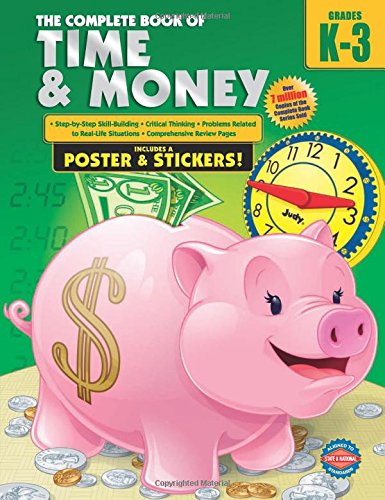
not in your house). Complete pages 6 - 7 from The
Complete Book of Time and Money. Allow her some time to make her
clock tell the times that are shown on the work pages (always winding it
clockwise and explain that's why we call it that: because it's the same way a
clock moves). I would let her use these pages up because she will use
them over several years.
Collect a good many pennies, perhaps at least
50, as well as probably at least 20 nickels, 10 or 20 dimes, and about 10
quarters in a container where you can keep them for use with money math
activities.
Turn to the mid-way point of The Complete
Book of Time and Money and talk about the system of money we use in the
United States, and again how that is beginning to change and we might stop
using coins by the time she is grown up. Talk about how we base our
system on the dollar. Show her a dollar and tell her that it equals
100 pennies. Show her some pennies. Tell her that five pennies
equal a nickel and show her a nickel. Let her count out five pennies
and stack them up beside a nickel. Tell her that ten pennies equal a
dime. Show her a dime and have her count out ten and stack them
beside a dime. Tell her that 25 pennies equal a quarter. Show her a
quarter and allow her to count out 25 pennies (helping, if needed) and stack
them beside a quarter. Complete pages 134 - 135.
Date each page as you complete it and put a
check mark to show you reviewed the work and helped her correct any errors.
Art/Music (Monday/Tuesday) /
Geography (Wed/Thurs) – 30 minutes (11:00 – 11:30):
Do any sort
of art project you’d like. You may want to decide what you will do
ahead of time and pull your materials together so you are ready to go at art
time! If it is rainy and bad outside, you might
look at some of the art exploration books I sent you and talk about those. Do free-form art projects not related to
history or science work (you will do other projects during those times). Otherwise, use your art books to help her
explore drawing on her own, or explore other art mediums of paint, pastels, collage,
etc. I sent you a whole stack of books
related to art, so just pull from those.
I know you have lots of supplies!
Just note what you do and either save the work (with the date on the
back), or take a picture of it to save with the date noted.
Listen to
great music: Kids’ CD’s that she likes,
or Classical Kids and other great, classical music. As you study different cultures, you can
listen to samples of music common in those cultures, too. Let her listen as she creates her art.
Here’s a
repeat of some info I sent you earlier regarding music and art appreciation:
When you
click on "more," additional info about each month's program is pulled
up, along with some sort of activity sheet.
Under the monthly programs, there are options to also listen to Italian
composers, instruments of the orchestra, etc.
There are also some good teacher lesson plans you could use throughout the
year. For instance, there's one for Aaron Copeland's music and they have
plans geared specifically for K-2. You download the info and there are
links to find the music free, online, as well as directions for related
activities.
If you go to this Classical Kids site, there are excerpts (pretty lengthy) of
their past productions, such as Vivaldi's Ring of Mystery and Beethoven Lives
Upstairs that you could watch and listen to in order to introduce her to some
fantastic classical pieces that are very well known:
http://www.classicalkidsnfp.org/classical-kids-live/
Also, for ART APPRECIATION, here is a free site where you can pull up any
pictures you (or she) like and read about them. Sometimes there are some
questions about them or you can just discuss yourself. The Simply Grammar
book will also have some art study included in it, for purposes of
narration....
http://gardenofpraise.com/art.htm
Lunch Time! (11:30 – 12:30):
This was just
a good, natural break time and I’m sure you will all be exhausted, at least at
first, by this time. During the lunch
hour, you can cover some P.E. and Health
topics just by allowing her free play (and noting it someplace by date), or
guiding her through some exercises in bad weather, etc. You can also periodically choose a health
topic and speak about it shortly as you eat or while preparing lunch. I also sent you several things on preparing
healthy snacks that you can sometimes use with her at lunch time. Just note what you do so that you can show
you are covering this topic (both for P.E., and health).
Here’s a
repeat of that info I sent you earlier:
These are potential questions (several pages of them) to add
to a first grade health test. Just reading through these will give you
ideas for little mini-topics on health that you should talk to her about.
These need not take more than 2-5 minutes. While you are eating lunch (or
making lunch together) you could bring up the topic casually.
"Health" need not be a topic regularly taught formally. You
live it out as part of your life:
And here's all you will need for the year on any topic to
help you talk about it! You can actually use this over the course of
SEVERAL years!
Here are some pages from The Complete Book of Science
that can be used, perhaps once a month:
Page 42 - 43. Talk about how the Food Pyramid was
used as a guideline for years but scientists finally admitted that it was
wrong and now it is not used any more. Fruits and vegetables should
really be moved to the bottom, with grains next (or even at the level of meat and
dairy).... Go ahead and complete the exercise on 43 related to it.
It is still relevant. We all need to eat more fruits and vegis and less
of the other stuff!
On another day, use page 44 and list what you had from lunch
from each food group.
Page 45 on another day - cut and paste items for each group
to cement understanding of different groups. Each day you can also just
ask, what food group is xxx in? Do you have a serving of fruit and a
serving of vegis? Etc....
Help her with page 47 to do a grain inventory of your pantry
one day.
Lastly, on another day, check memory of the food groups by
helping her to write in which group each of the listed foods belong to....
Make "Tummy Yummies" one day, page 39 (Need honey, peanut butter, dry milk)
Make "Brainfood Cookies" on another
day, page 39 (Need softened butter, oatmeal, brown sugar,
flour, baking powder) I would add raisins,
too, or chocolate chips - yum! chocolate chips, definitely....
On another day, use the "Healthful Habits"
activity from page 40 - create a public info commercial!
Doing Health
once or twice a week and using these activities about once a month will, I
think, get you through the entire school year!
 (Hard to find these books any more, as they are out of print - but they are terrific!)
History (Monday, Tuesday) / Science (Wed / Thurs) – 12:30 to
2:
Ancient History – SOTW I Books I sent you in purple
Library books in green
Week 1 Things you may need to look at ahead of time, blue
Day 1
SOTW Intro – What is
History and what is archaeology?
Read Usborne Ancient World, page 3.
Read intro from SOTW. The
Activity
Guide has some examples of
review
questions (and possible answers) for you to use following each chapter of
the book in order to make sure she understands what you are reading.
Ask her some of these after you’ve read each
chapter.
Don’t stress her about it,
though!
You want history to be fun for
her!
Read any other library books you
were able to obtain, such as:
Me and My Family Tree
Archaeologists Dig for Clues
I Can be an Archaeologist
The Magic School Bus Shows and Tells
(use for reading time)
Do an archaeological dig. If you
have a sand box or an area of dirt near the house that is pretty loose and easy
to dig, bury some interesting rocks, shells, plastic dinosaurs or other items
for her to dig and find. Use some small
gardening trowels, etc. for initial digging but also provide some paint brushes
she can use to gently brush the dirt from items as she finds them….
Make “Cave Art” –
Take a brown paper bag or brown, heavy craft paper
and wet it slightly as you wrinkle it up.
This results in an old, leathery look when it dries – sort of like a
dried animal skin. Do this ahead of time
so the paper will be dry when you are ready to use it. Either burn the edges or cut them unevenly to
look like a skin. Use this as your base
for art work. Let her make stick
figures, animals such as those you’ve seen in your books (or can pull up
online: Caves of Altimira, Las Caux,
etc.) You can sketch with a pencil and
overshadow with oil pastels or chalk (and I would spray with a fixative if
using chalk)….
Make a “Coil Pot”
– Use some of your air dry Crayola “clay” – just in
white or a natural color, if you have that, and create a nice, long cigar or
dowel shape. I would say about two feet
long. Begin to coil it tightly around itself
to form a small base, I’d say about 4 inches in diameter, then start to stack
the coils up to form the sides of the bowl.
Make sure you are pressing down slightly to get each round to stick to
the one before it. This clay is rather
dry and not that sticky, so you have to pay attention to that. You might take an orange stick or other
pointed item and make some cross hatching marks in the side of the bowl, if you
want, after you finish it. Or just leave
it smooth. We still have one of
these that Liam made at this age! You
can keep it in your school room to store small items, such as counters, or your
paper clips, etc.
Jot down what you do each day, take pics of projects if not
saving them, list the books you read, and add any map work or coloring pages
she does from the activity guide to this section of your record keeping book.
Day 2
Bible (8:00 – 8:15):
Continue with Lord’s Prayer,
memory work, readings from Bible story books, etc.
Reading / Phonics (8:15 – 8:35):
Phonics Pathways, page 21 and 23. This is more of the two letter
blends. I think these are more confusing than helpful, as some of them,
like "so" yesterday, are two letter words that will have very
different sounds later, so I don't like these. I would help her through
these two pages today, emphasizing the short vowel sounds, and the second page
ends with a three letter word, "ran." I think it will be better
to move on to three letter words for learning to read. These more typically
make the correct short vowel sound in the middle. At first, you just
repeat one or two of the words and have her follow you, then see if she will
try them herself. Keep prompting her if she won't try. For
instance: What sound does the letter 'm' make? Mmmmmmmmmmm.
What is the short vowel sound for the letter 'u'? Remember, the vowels
say their name when they make the long sound, but the short sound is
different. 'U' makes the uhhhhh sound.... Put those together:
mmmmmmuhhhh....
Again, this book presumes that you may be either starting with a pre-schooler
who may not know all their letters and their sounds perfectly (and Kindergarten
should have taught her this), or an illiterate person who may not have ever
read and so may not know the alphabet well. Assuming she knows her
letters and sounds, these two letter "words" are not all that helpful
and may be confusing, so I think it's best not to use too many of them.
That's all for today. Tomorrow you will start three letter word blends
which I think will make more sense to her.
Literature / Read Aloud Time (8:35 –
9:05):
Choose a bug
related book from your list provided yesterday.
Choose any of the fictional books you were able to get from the library that
are related to your history studies for this week, such as:
Mik's Mammoth
One Small Blue Bead
The First Dog (read one; save the others for the next day or so….)
Talk about the difference between fiction and
non-fiction. Remind her that these books
are all informational, in that they tell you about something important related
to science or history, but they are not about real characters or things that
really happened, so far as we know. The
stories are made up by the author (assuming that is true for the bug book you
choose – or it may be purely fanciful, like The Ants Go Marching, etc.)
Spelling / Writing / Grammar – (9:05 – 9:35):
Day 2
Spelling, page 6 -
same as yesterday.
Handwriting, page 2.
Practice with the letter 'a'. Write slowly and neatly, first tracing,
then making your own letters and words. Copy the letters to the end of
the line. Put your best effort in the box. Copy at least three
words. Trace and then copy the sentence once.
Notice that along the bottom edge of each page, it will tell
you things you are working on - short i and short a for this page. On
other pages you will work with some sight words, punctuation marks, etc.
Grammar, FLL, Lesson 2
- introducing poem memorization (you will do poems all year as part of grammar
work - this is cross-curricular with literature - ANY memory work at this age
is excellent for training the brain!)
Morning Math (9:35 – 9:55):
Look at your nice calendar - Today is Tuesday,
August 11, 2015. Have her repeat that after you. Yesterday
was Monday, August 10, 2015 - your first day of school. Have her
repeat that date. When we put numbers in order, we often count them by
using what we call "ordinal numbers" to show their place in
line. For instance, yesterday was the "first" day of
school. Today is the "second" day of school. Tomorrow
will be the "third" day of school. Each day you will
say the date and ordinal number for that day.
Print out some of these pages to use to keep a
number scroll for the number of days of school:
(I have the file for this and can email it to
you; I am also sending you a couple of pages. I don't have a link for
it.... I think it was a PDF….) Do you have a good copier that you can use at
home?
Just write the number one in the first
box of the first page (after 0). Tomorrow write 2 and so on. When a
page is full, tape or glue the edge of the next page to it. Tape or glue
the top edge of the first page to an empty paper towel roll to create a scroll.
Keep a rubber band around it when not in use. Add to this each day.
On a sheet of lined first grade
paper, write today's date: Tuesday, August 11, 2015 -
note that the day of the week and month are always capitalized and we always
put a comma between the day and the number of the date. Do this every
day.
Get out your Thermometer. Take the temperature outside by leaving it in the same
place all the time. So perhaps find a place where you can tape it, using
duck tape, to an outside window that is low enough for her to see the numbers
and read them each day. Mention that if this is in sun or shade,
the temperature might be a little higher or lower than it is elsewhere (try not
to have it in hot sun). Show her how to read the thermometer and help
her with this each day until she gets the hang of it. On the whiteboard
portion of your calendar board, you might make a space taking up half or
a fourth of the board for keeping temperature info for the month. Just
put the date: 11th - 79 degrees (use the degree mark - I don't have
one on my computer). Explain to her what the degree mark means and
what "th" means (more on ordinal numbers). She will read
the thermometer and you will enter the temperature each day, with her repeating
it. "Today is the 12th and the temperature is 81 degrees,"
etc....
Also draw a small pic of sun if
it is sunny, clouds if cloudy, rain drops if raining, snow
if snowing, etc. At the end of each month, you will tally how many
days you have that were sunny vs. cloudy vs. rainy, etc. This will
give her practice with making tally marks. You can also create a graph
sometimes and graph it, to give her work with that, as well....
Spanish (9:55 – 10:10):
Day
2
READ THE FUN FACTS
Re-listen through Chapter One and fill out the written exercises, such as
checking off the names of the other children, writing in your name (saying the
phrases as you do), filling out the number of items, matching the ages (saying
the numbers as you do), filling in your own age (and saying those phrases as you
do).
Primary Math (10:10 – 10:30):
Singapore Primary Math 1A workbook
Part One
Do Workbook exercises one and two, using plastic cover sheets if
you wish to keep workbooks clean for later use again. Hmmmm, what to do
about coloring on page 8? Let her color on the plastic? or copy the page?
Practice counting forwards and backwards to ten. Also start
practicing counting by 2's and show her 5 sets of two bears each to show her what you are doing by
counting by twos.... Also, tell her that when counting by 2's, we are
always counting what we call "even" numbers.
Civics (10:30 – 10:40):
Continue with suggestions from Monday.
Math Enrichment (10:40 – 11:00):
Complete Book -
continue with Time and Money topics for this month to cement those
basics. Complete pages 8 - 9 and 136 - 137, allowing her time to
play some with the clock to make it show the times shown on the work
pages. Ask her some time and money questions and let her use the
manipulatives to answer them. For example: You have 8:00 showing on
your clock. Can you show me what time it will be one hour later?
(or earlier? but if earlier she will have to wind the clock all the way back
around because she should not wind it counter-clockwise....) Or, you have
10 pennies there, but how many would you have if you took 2 away? Etc.
Add in Pattern Block Book w/ CD - I can't find a BIT
of info on the number of pages in this book. This year, use the sections
on "Explore and Discover," "Numbers and Operations,"
"Geometry," and "Measurement." I can't find what the
CD is for, either, so can't help much with this. I am assuming that the
items in the first section are simpler, so do one of those activities from
"Explore and Discover" and let her play with her
Tangrams, or pattern blocks during any time you have left in this period
each day for this month. I would let her use up this book because she
will use it over several years.
 (Most of her baseline books came from Rainbow Resource Center.)
Art (last day this week) / Music (11:00 – 11:30):
Enjoy art activities or enrichment while listening to good
music or fun kids’ pieces. See Monday
for suggestions.
Lunch (11:30 – 12:30):
Work in P.E. time and perhaps more health (if you do it
today, you are done for the week as I think twice a week is plenty for health
topics). Just make certain to write down
the date and what she did (how much time for free-play or exercise, etc.). Refer to links and suggestions from Monday.
History (last day this week) – 12:30 – 2:00:
Day 2 (Week 1)
Read Chapter 1, SOTW
– The Earliest People
Usborne, pages 4-5
Read any other library books you were able to obtain, such as:
It’s Disgusting and we Ate It!
How People First Lived
Mik's Mammoth (use these last three for
literature)
One Small Blue Bead
The First Dog
And/or Read books I sent you:
Who Were the First People?
Living in Prehistoric Times
Attempt a simple weaving project (need yarn and either
an old Styrofoam tray or you could also use a piece of thick cardboard from a cereal
box, etc. as your base):
Day 3
Bible (8:00 – 8:15):
Continue with Lord’s Prayer, memory work, etc. (See ideas
listed on Monday.)
Phonics / Reading (8:15 – 8:35):
I don’t have available to me anything showing the full index
of Phonics Pathways, so I’m not sure
if the three-letter blends start on page
24 or shortly after that. But turn
to the first page that is all three letter blends and start there. Those are your typical rhyming word families
that will allow her to really use her short vowel sounds more easily. There are also many of these to be found in
the little mini-books workbook that you have.
So if you are doing “-an” word family for the day, see if you have a
mini-book she can make that uses that same word family. If you are using the “-at” word family, look
for a mini-book to go with that, etc.
After she makes the little book, she can “read” it herself! Keep these and let her re-read them
periodically over the next few weeks as she learns to read.
Just
read one page a day from PP!
That’s enough. Then, if you have time, look for and make a
mini-book that goes with the words she read. Or,
pull out your phonics flash cards and pick out some of those that are the same
family of words you read that day and let her “read” those (and you might
want to keep those out separate and add a few more to them each day, mixing
them up and continuing to let her “read” from them….) You can mix things up a
bit and do one or the other each day.
Next week, you can start to add in your Bob books, too….
Read-aloud / Literature (8:35 – 9:05):
Choose another one or two of your fictional bug books to read
today. Any time you happen to come to
one of the words that she has read that day, let her read it out of the story.
Also choose one of the fictional books related to history to
read (see list from yesterday). If you were not able to obtain all of these, use classic
children’s literature for reading time (any books you have at home, or get
classics from the library such as Frog and Toad, Amelia Bedelia, Nate the
Great, Wind in the Willows, etc., etc.)
Spelling, Writing, Grammar (9:05 – 9:35):
Day 3
Spelling, page 7 -
same thing....
Handwriting, page 3
- practice with 'A'
Grammar, FLL, Lesson 3
- common nouns (and, again, if the repetition begins to drive everyone crazy,
cut out some of it or modify it).
Morning Math (9:35 – 9:55):
Day 3
Look at calendar. Today is Wednesday,
August 12, 2015. Tomorrow will be ___________________ (help if
needed, but try to get her into being able to say these herself....) Monday
was the first day of school. Yesterday, Tuesday, was the
second day of school. Today is the __________ day of
school (help if needed)....
Read thermometer (help as needed
until she gets the hang of it). Tell her that we read our
thermometer in number of degrees "Fahrenheit" - a name that comes
from the person who discovered this way of telling temperatures. Other
countries and scientists read their temperatures in degrees
"Centigrade," which are a little different - and we will learn to do
that later. Record day / temp on whiteboard and whether it's sunny,
rainy, etc. Let her decide this, so she needs to look well, all over
the sky, to be certain.
Have her add to her number scroll and write
today's date on lined paper (helping her with spelling, capitalization and
commas, as needed).
Spanish (9:55 – 10:10):
Day
3
Draw the picture of yourself and write in a speech bubble. Practice the
phrases on the page.
Primary Math (10:10 – 10:30):
Singapore Math Workbook
She is going to start to get practice with
"ringing" items (circling them), as well as "ticking" them
(placing a check mark), so help her get used to this.
Do Workbook exercises three and four.
Is she having difficulty with writing any number? With getting numbers correct
when counting items? With counting backwards or skip counting? Practice
more and use counters if necessary to help her cement this basic knowledge.
Civics (10:30 – 10:40):
Review ideas from Monday and continue with work on symbols,
etc.
Math Enrichment (10:40 – 11:00):
Complete Book pages 10 - 11 and 138
- 139. Use clocks to make the times shown
on work pages and practice counting some additionally with money, with you
asking questions.
Continue with Pattern Block Book "Explore and
Discover" section, using Tangrams for reinforcement and extra work (didn't
I send you that set of Tangram puzzles already? There is also a big set
of pattern blocks in with the math manipulatives I sent you for Eli that you
can use with her, too....)
Geography (11:00 – 11:30):
You will study the United States for “geography” this year. Of course, you will have maps to do that go
along with your history studies for world studies, so this will help make sure
you also cover some info on the U.S. (for testing purposes, in the spring).
Start from the familiar.
Use the green section of the Nat Geo U.S.
Atlas book that I am sending
you. Start with your home state: Minnesota.
Read the two page spread on
your state, pages 100 – 101. Look over the map and show her where you
live. Show her neighboring states and
where the grands live. Show her how
close you are to the country of Canada (road trip!). Look at page
6 and show her that this is the key
for the entire book that shows icons (pictures that represent something) for
things that are grown in the state, types of business, etc. For instance, the gold bar near you
represents that mining goes on nearby.
Talk to her about what mining is. Show her on the small U.S. map at the
bottom of page 101 where Minnesota is in relation to the rest of the states in
the U.S. Have her pick out the forests
and lakes, etc. Really explore the map
with her.
If you have time left, start to read some picture books
related to Minnesota, such as these from your library:
Agate: What Good is a Moose?
Agate, Bear, Canoe: A Northwoods Alphabet Year
Antler, Bear, Kazoo: A Northwoods Album of Songs
Big Belching Bog (Oh, man!
You need to go visit a bog!)
Gathering:
A Northwoods Counting Book
Good Night Minnesota
I Spy with my Little Eye: Minnesota
The Legend of Minnesota
Lena and the Lady’s Slippers…
M is for Minnesota – 2 titles
Marven of the Great North Woods
Minnesota – 3 titles
Minnesota’s Hidden Alphabet
Read from these books, as time allows, today and
tomorrow. As you read about a particular
place, look it up on your map in the Atlas.
Keep that book open beside you as you read so you can refer to it often. As you read about bogs show her how those are
marked on the map….
Keep a listing of what you do each week for geography
work. Remember to note all your work in
every subject, either in the book itself or in a record book that you
keep. This keeps you accountable and
also provides a solid record that anyone can look over to see what you’ve
accomplished during the year.
Lunch (11:30 – 12:30):
Note what she does physically for your P.E. time. If you’ve already covered health twice this
week, you are finished with that for now.
Science (12:30 – 2:00):
Week
1
Day
1
Read from your Kingfisher First Book
of Animals regarding whichever insect you
decide to study for the day. Pages are found in the Invertebrate section, starting with "Insect" on page 134 and going on to the end of the
section. Just read the general intro on bugs this first day and then read about crickets and grasshoppers if
there are entries for them….
Then read from library books such
as:
Bugs, Jennings
Bugs are Insects (general intro to bugs)
Are you a Grasshopper?
Wee Sing and Learn Bugs (continue next several
days)
Try to do about 30
minutes of reading; about 30 minutes
of hands-on activities such as those below; and about 30 minutes of work outside (in this case, try to catch and observe some crickets and grasshoppers, sketch them, etc.)
Other cricket activities and exercises:
I am giving you two bug
viewing containers that you might use if you catch some things that
you'd like to view and sketch before releasing.... I think you already
have a bug box (sensory box) that you could use with Eli along with this,
too. I believe there's at least one of those little bug's eye view
viewers in there. You look through it and get a sense of how bugs see
things.... Talk about compound eyes,
etc.
To help fill out your study - or for rainy days or time back home, I am sending
you a build-your-own- bug sort of set. It is called Amazing Bugs.
You snap on moving legs or wings, etc. to various bugs as you read
through the book. Some of the snaps are kinda hard to work, but you can
just lay them on if you can't snap them....
(I will fit this in to the study later….)
There's also a Janice Van Cleave Insects and
Spiders Science Fair Project book. Not that you have to be
entering a science fair to use these experiments.... You can use some of
these to guide your outdoor nature study time. For instance: the
first project: Catchers. You could experiment with different ways
of catching insects. The second project: Diggers. Go play in
the dirt and see what kind of insects (or insect parts) you find
there.... The third one:
Jointed. Catch a cricket (or grasshopper) and look up close at its
jointed parts, using a magnifier or your Brock's Magiscope. Sketch what
you see!
Some
common facts about insects you should have her work on memorizing:
All Arthropods have an exoskeleton (how would you
like to have your skeleton outside your body?)
All have segmented bodies and jointed appendages.
All are invertebrates (no spinal column).
Arthropod phylum includes the: Insects, Arachnids, Myriapods (millipedes
and centipedes) and Crustaceans (most of which live in the sea, save for the
Pill Bug).
Insects have 6 legs. Arachnids (spiders and their kin) have 8 legs.
Most insects have wings at some point in their lifespan, even if they unhook
them and don't keep them all their lives (like ants do, after migrating to new
colonies).
The only common insects that never have wings are fleas, lice, and silverfish.
You might want to make flashcards
for this bug info memory work.
Workbook Pages from
The Complete Book of Science to
go along with Bug Study:
These pages are all perforated so if you are using both
sides of a page (or one side is blank), you can pull them out of the book as
you use them and store them elsewhere. I used to keep a big three-ring
notebook with tabs for each subject and I would hole punch pages if needed and
place all work in order behind the appropriate tab as we went through the
school year. That way, if I ever needed to refer back to something or
show it to someone, it was handy and in order. Just date the top of your
pages (I usually did that in the name blank provided) so you can demonstrate
when the work was completed.
With
your General Intro to Insects, read page 70 and color the general insect on
page 71. Work on memorizing the main parts of an insect over the course
of the week. Do the general insect arts and crafts on page 72.
Complete the general insect crossword on page 74.
Day 4
Bible (8:00 – 8:15):
Continue with Lord’s Prayer, Bible stories, memory work,
etc.
Phonics / Reading (8:15 – 8:35):
Read
the next page from PP.
Then, if you have time, look for
and make a mini-book that goes with the words she read today. Or,
pull out your phonics flash cards and pick out some of those that are in the
same family of words you read today and let her “read” those (and you might
want to keep those out separate and add a few more to them each day, mixing
them up and continuing to let her “read” from them….) You can mix things up a
bit and do one or the other each day.
Read-Aloud / Literature (8:35 – 9:05):
Choose another one or two of your fictional bug books to read
today. Any time you happen to come to
one of the words that she has read that day, let her read it out of the story.
Also choose one of the fictional books related to history to
read. If you were not able to obtain all
of these, use classic children’s literature for reading time (any books you
have at home or get classics from the library such as Frog and Toad, Amelia Bedelia,
Nate the Great, Wind in the Willows, etc., etc.)
Spelling / Writing / Grammar (9:05 – 9:35):
Day 4
Spelling, page 8 - more
of the same. This is just a beginning of the year review for younger
kids....
Handwriting, page 4
- practice with letter 'b'
Grammar, FLL, Lesson 4 -
proper nouns
Morning Math (9:35 – 9:55):
Day 4
Today is ________ (help with
this.) Yesterday was __________. Yesterday was the third day of
school. Today is the ______ day of school (help if needed). Add to
number scroll. Write today's date. Read thermometer. Record
the date and temp, with her repeating it, and let her decide if it is sunny,
etc.
If this is running smoothly, then add in your Hundred
Number Chart here. Or you can wait a while if you think you don't
have time for it yet. You will just use the tiles that go with it and
allow her to practice counting with them. After she has gotten several
numbers on the chart, say 20 or so (pull out
just the first twenty or twenty-five tiles first, so there are not so many that
they overwhelm her or it takes too long....), play
a mystery number game with her: Tell her you are thinking of a number
that is larger than 10 but smaller than 20, for instance. She can remove
all the numbers that do not fit that clue (1 – 9 and maybe 21-25, if you go
that high). Then tell her that the number is larger than 15 (she removes
10 - 14). Now tell her that the number is an even number, meaning it has
to end in 0, 2, 4, 6, or 8. (She removes odd numbers - so she should
have 16, 18 and 20 left.) Tell her the two digits of the number added together
equal 9 (so 18). If this is too difficult for her, simplify or wait until
later....
Spanish (9:55 – 10:10):
Day
4
The
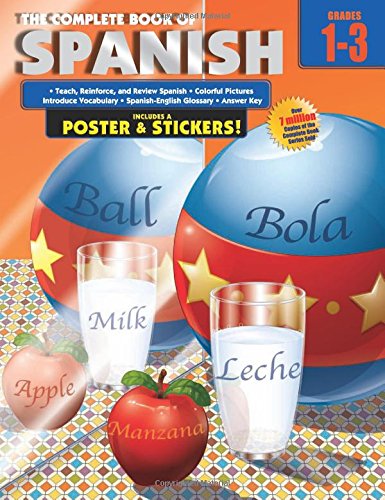
Complete Book of Spanish - write your name on page 4,
practicing the phrase in Spanish, then look at and practice saying your numbers
on page 5 and 6.
Complete workbook page
8.
(I would actually use up this workbook with her as you will use it for several
years. Just put your date and her grade at the top of the first page and
then the date on each page from here on out so you can prove when the work was
done. Include the year in the date since you will use this for several
years. Even on pages where you don't actually write anything, such as
pages 5 and 6, write the date and put "oral" or "orally" or
"oral work" or something to note what you did.)
Primary Math (10:10 – 10:30):
Use Singapore Math Practice 1A for more extra practice. (I got this
cheap at my local Parent-Teacher store!)
Do pages 13 (examples) through 18. Use plastic sheeting if you
want to keep the book clean for later re-use. Just instruct her on what
to do for each page and watch to see if she can do it. If she can do it
on her own (correctly), allow her to - if not, then step in to redirect.
Civics (10:30 – 10:40):
Continue with your work on national symbols.
Math Enrichment (10:40 – 11:00):
Complete Book pages 12 - 13 and 140
- 141. Use clocks to make the times shown
on work pages and practice counting some additionally with money, with you
asking questions.
Continue with Pattern Block Book "Explore and
Discover" section, using Tangrams for reinforcement and extra work.
Geography (11:00 – 11:30):
Continue reading from books listed yesterday regarding
Minnesota. Use the map in your Atlas to point out places mentioned, etc.
Lunch (11:30 – 12:30):
Make certain to note anything done for P.E. today (or
health, if not completed for the week)….
Science ( 12:30 – 2:00):
Day
2
Read
from your Encyclopedia about Ladybugs, if there is info in there on them
(may just be beetles in general). Read about any other beetles, too, like
lightning bugs. You don’t have to read
every single spread if there are tons on the same type of insect!
Library books to choose from:
Bugs that Help
Bugs that Destroy
Show Me Insects (just general books – not beetle
specific)
Living Lights:
Fireflies…
Some experiment ideas for
lightning bugs (do you have those up there?) – they are really a type of
beetle, too:
Continue practicing with info you want her to memorize and
with any of the worksheets you did not have time to finish yesterday, then go
outside to look for ladybugs or other beetles seeking hibernation under loose
bark, etc. At dusk, you might try to
catch some lightning bugs, if you have those (or still have them at this time
of year) and then you can do that activity to see how quickly they light up,
etc.
Whenever you do an experiment, write down the date/time and what you
did, what happened, and what you learned from it (this can be one sentence for
each of these that she dictates to you).
Store these in your record keeping notebook under your science tab.
You have on hand Creepy Crawlies and the
Scientific Method as a reference tool for you. It has chapters on all
sorts of insects that include loads of background info for you; possible
questions (with answers) that you might want to ask her to keep her thinking;
and many different types of experiments; also info on how to keep these
critters alive in order to observe them.
Also make sure to check out your book: Attracting
Wildlife to Your Backyard. It has monthly projects you can do
to help make sure you see as many animals as possible!
Also use your Natural Science Through the Seasons (probably still summer
if you are in August) to give you more ideas for projects!
With Ladybug study, do page
75 Complete Book of Science (Ladybug lunch: (You
will need at least one red apple, 2 seedless grapes, 2 lettuce leaves, 2
tablespoons of peanut butter, 6-10 raisins and 7 toothpicks.) The picture is incorrect and shows the raisins on the cut
side of the apple. You are supposed to put them on the skin side (black
on red).... You may not have time to do
it today, but you can do it as a treat at lunch tomorrow (no formal history or
science tomorrow!)
I am also sending you three bug “masks” that can be colored with markers or painted, etc. (One for each of them!) They might like to work on those on Friday
when there is more time, too….
On your library list you also have an origami bug book, a book to help you learn to draw
bugs, and a craft book for kids
learning about insects. You might want to explore those on Friday….
Day 5
Bible (8:00 – 8:15):
Continue as before.
Reading / Phonics (8:15 – 8:35):
Read
the next page from PP.
Then, if you have time, look for
and make a mini-book that goes with the words she read today. Or,
pull out your phonics flash cards and pick out some of those that are in the
same family of words you read today and let her “read” those.
Read-Aloud / Literature (8:35 – 9:05):
Try to finish up any lit related books from science or
history topics today. If already
finished with those, just choose to read some good classic works (you could use
those Dandelion books I sent you, too!)
Or read more geography books related to Minnesota. If you have extra books that are general lit
that you didn’t read yet, hold them over in case you need them next week.
(Remember to re-check any that might be coming up for renewal! You can probably do this online, without
having to go in.)
Spelling / Writing / Grammar (9:05 – 9:35):
Day 5
Spelling - Just
for fun, practice spelling aloud five or six of the rhyming words she has done
this week for phonics, such as the -an family, for instance: fan, can,
ban, ran, man.... Talk about any words she might not know (ban,
perhaps....)
You might prefer to let her do her spelling tests out loud
for now, rather than writing them - unless she is a very strong writer right
out of the gate. Just make a note for that day of what words you tested
her on and how she did (as proof of what you are studying - in case you ever
need it).
Remember to start a "Trouble Word" list if any
words are missed. You will review this next Friday. Keep it behind a tab for “Trouble Words” in
the Spelling section of your record book….
Handwriting, page 5
- practice with letter 'B'
Grammar, FLL, Lesson 5 -
introducing story narration. This is an important part of early grammar
work and it is important to get her to add as much detail as possible and speak
in complete sentences. This
will help with writing in complete sentences later on. So, instead of you asking, a question like,
“What are your brothers’ names?” and her answering as she typically would
orally, “____ and _______,” you want her to answer in a complete sentence: “My brothers’ names are ___ and _____.”
Morning Math (9:35 – 9:55):
Today is ________ (help with
this.) Today is the ______ day of school (help if needed). Add to
number scroll. Write today's date. This is the end of our first
week of school. Tomorrow will be
__________. Read thermometer. Record the
date and temp, with her repeating it, and let her decide if it is sunny, etc.
If using the Hundred
Numbers Chart, continue to practice
counting with the tiles for that. Play mystery
number game with her if she did
well with that yesterday.
Spanish (9:55 – 10:10):
Day
5
Complete
Book - practice counting the balloons on page 7.
Complete workbook page
9.
Sing the songs from Chapter 1 in SfC
again and/or look at the back of your Complete Book and sing some of those songs (page
205 are all good for now). "Diez Amigos" on page 206 will work
now; the "Name Chant" on page 209 is good for what you are studying
now, as is "Adios Means Good-bye."
Primary Math (10:10 – 10:30):
Continue in Math Practice, doing pages 19 -23.
On page 23 she may need help with you spelling the words as she writes them, or
you can even help her with the writing if need be....
Civics (10:30 – 10:40):
Continue with work on symbols, etc.
Math Enrichment (10:40 – 11:00):
Complete Book pages 14 - 15 and 142
- 143. Use clocks to make the times shown
on work pages and practice counting some additionally with money, with you
asking questions.
Continue with Pattern Block Book "Explore and
Discover" section (or the next section, if you have finished the first
one), using Tangrams for reinforcement and extra work.
Rest of day:
Lunch
Do any other reading you haven’t gotten to yet for
geography, history or science. Do more
science projects, art activities, etc.
Go outside if it’s nice! Look for
bugs!